Why was my flight delayed for "weather" when it's sunny here?
The weather that matters may be at your destination or along the route. When storms or low cloud cut how many flights an airport can take, the FAA holds departures on the ground elsewhere, so your plane waits at the gate instead of circling.
In this article · 7 sections
The weather is probably somewhere else
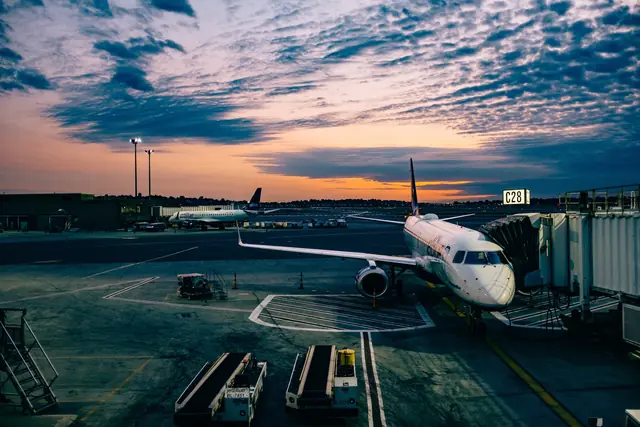
It's a common frustration: blue sky at your airport, and a departure board saying "delayed, weather". The weather in question is usually at your destination, or in the airspace you'd fly through. If thunderstorms or low cloud reduce how many flights can land there each hour, every flight heading that way is affected, wherever it starts.
Waiting on the ground, by design
The FAA's main tool for this is a ground delay program. In the FAA's own description, aircraft are held on the ground to manage capacity and demand at a specific location by assigning arrival slots, and one purpose of the program is to limit airborne holding.1 Each flight gets an expect departure clearance time (EDCT), calculated from the flight's arrival slot and its expected time en route.1
So instead of taking off on time and then circling near a storm-hit airport, your flight waits at the gate and takes off when there will be room to land. It.s a calmer way to absorb the delay.
When the problem is the route
Sometimes the bottleneck is a block of airspace rather than an airport, for example a line of storms across a busy corridor. The FAA can then run an airspace flow program, which assigns arrival slots and departure times for flights passing through that constrained area, or offers reroutes around it.2 That's why a flight can be delayed for weather between two sunny cities.
When it's more sudden
If capacity drops sharply with little warning, the FAA may call a ground stop, keeping certain flights on the ground for a while.3 We explain those in What is a ground stop?.
How to check what's happening
The FAA publishes current ground stops, delay programs and airport delays on its National Airspace System Status page.4 My Flight also shows official weather at both ends of your trip, which often explains the delay.
Is it safer to wait?
A weather delay is the system choosing caution early. Nobody is pushing your flight into weather; it's being spaced out so that it arrives when the destination can take it.
Keep reading
- What is a ground stop?
- Why is my plane circling? Holding patterns, explained
- Thunderstorms: why pilots go around them
- Is it safe to fly in snow?
Quick answers
Why is my flight delayed for weather when the sky is clear?
Because the weather causing the delay is often somewhere else: at the airport you're flying to, or along the route. If that airport can accept fewer arrivals, flights heading there are given later departure times.
What is a ground delay program?
An FAA traffic management program that holds aircraft on the ground at their departure airports and gives them arrival slots at a busy or weather-affected airport. One purpose is to limit airborne holding.
What is an EDCT?
An expect departure clearance time: the takeoff time a flight is given in a ground delay program, calculated from its arrival slot and the expected flying time.
Where can I check FAA delays?
The FAA publishes current ground stops, ground delay programs and other delays on its National Airspace System Status page, nasstatus.faa.gov.
Sources
(4)
- FAA Order JO 7210.3, Section 18-10 Ground Delay Programs
- FAA Order JO 7210.3, Section 18-11 Airspace Flow Programs
- FAA Order JO 7210.3, Section 18-13 Ground Stop(s)
- FAA National Airspace System Status
Facts last checked against these sources: October 18, 2026.