Is it safe to fly in snow?
Snow slows airports down, and that's the point. Wings must be clean before takeoff, runways are cleared and reported in a standard way, and traffic is metered so nobody rushes. Here's what's going on while you wait.
In this article · 7 sections
Snow makes everything slower, on purpose
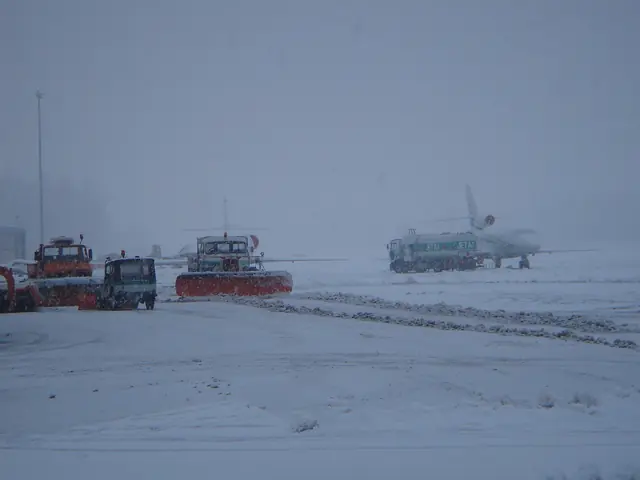
A snowy airport can look chaotic from the gate. What's actually happening is a set of rules and routines that all trade speed for safety: clean the airplane, clear the runway, measure it, and only send as many flights as the airport can handle.
Rule one: the wings must be clean
US airline rules are simple on this point. No one may take off with frost, ice or snow adhering to the wings, control surfaces, propellers, engine inlets or other critical surfaces.1 When conditions are such that snow or ice could stick, the airline must have an FAA-approved ground de-icing and anti-icing program and follow it, including timetables for how long the protective fluid works and a check that the critical surfaces are clean before takeoff.1 If that time runs out, the airplane is de-iced again.
That's why you might get sprayed at the gate or at a de-icing pad, and sometimes twice. Our de-icing explainer walks through what the fluid is and why it's orange or green.
The runway is cleared, then reported
Airports work to written snow and ice control plans. The FAA's winter guidance tells them to clear the most important areas first: the primary runways, the taxiways leading to the terminal, and the routes emergency crews need.2
Once a runway has snow, slush or ice on it, the airport assesses it with a standard matrix and reports a Runway Condition Code for each third of the runway, in a short format such as "4/3/2".2 Pilots use those codes to work out the takeoff and landing performance they need.2 This system, called TALPA, exists to give pilots an accurate, consistent picture of a runway that isn't dry.3
Why your flight is held at the gate
Clearing and de-icing take time, and fewer flights can land per hour. When an airport can accept fewer arrivals, the FAA can run a ground delay program: departing flights elsewhere are given a later takeoff time so they arrive when there's room. One stated purpose is to limit airborne holding.4 In other words, you wait on the ground instead of circling.
Who decides whether to go
You don't have to judge the weather yourself. US airline rules say no flight may be dispatched, continue en route or land when, in the opinion of the pilot in command or the airline's dispatcher, icing conditions are expected or met that might adversely affect safety.1 A cancellation on a snow day is that rule working.
What you might notice
- A long wait before pushback, then a stop at a de-icing pad.
- A spray of fluid running down the windows.
- A slower taxi on clear-but-white taxiways.
- A climb through grey cloud, often into sunshine above it.
Keep reading
- De-icing: why the plane gets sprayed
- What is a ground stop?
- Why was my flight delayed for weather when it's sunny here?
- Check conditions at both ends with My Flight
Quick answers
Can planes take off when it's snowing?
Yes. US airline rules don't allow a takeoff with frost, ice or snow stuck to the wings, control surfaces, propellers or engine inlets, and when snow could stick, the airline must follow an FAA-approved de-icing program. With that done, flying in snow is routine.
Why do snow days cause so many delays?
Runways and taxiways have to be cleared, aircraft have to be de-iced, and arrival rates can drop. When an airport can accept fewer flights, the FAA may hold departures on the ground elsewhere so planes aren't left circling.
How do pilots know if a snowy runway is slippery?
US airports assess contaminated runways with a standard matrix and report a Runway Condition Code for each third of the runway. Pilots use those codes to work out the takeoff or landing performance they need.
Is it safer to wait for the snow to stop?
You don't need to make that call. The rules put the decision with the pilot in command and, at airlines, the dispatcher: they may not dispatch, continue or land a flight when icing that might affect safety is expected.
Sources
(4)
- 14 CFR § 121.629, Operation in icing conditions
- FAA Advisory Circular 150/5200-30D, Airport Field Condition Assessments and Winter Operations Safety
- FAA, Takeoff and Landing Performance Assessment (TALPA)
- FAA Order JO 7210.3, Section 18-10 Ground Delay Programs
Facts last checked against these sources: October 18, 2026.