Scared of flying at night?
A dark window, a dim cabin and a tired mind can make a night flight feel scarier than the same trip at noon. Here is what actually changes after dark, what the rules say about lights and pilot rest, and a plan for the moments that feel worst.
In this article · 7 sections
Flying soon? Our 7-day program walks you through your trip one calm step a day, and you can try a lesson free first. See what's inside.
If you're in crisis in the US, call or text 988 any time (988 Suicide & Crisis Lifeline). In an emergency, call 911, or ask any airport or airline staff member for help. This page is general information, not medical advice.
Why night flights can feel scarier
If an evening or overnight flight makes you more nervous than a daytime one, you're not imagining it, and you're not alone. Lots of nervous flyers say the same thing: the window goes black, the cabin lights dim, everyone else falls asleep, and suddenly every bump and engine change feels louder.
Very little of that is about the plane. It's about you having less information and less energy. In daylight you can see the wing, the clouds and the ground, and your brain uses those clues to tell itself everything is fine. At night those clues disappear, so an anxious mind fills the gap with guesses, usually the worst ones. And when you're tired, it's harder to argue back.
With winter holidays coming and the sun setting before many people even get to the airport, plenty of Thanksgiving and Christmas trips will be partly in the dark. Here's what actually changes, and what doesn't.
Flying soon? Save the free Calm Flight Checklist to your phone, and keep Right Now one tap away; it talks you through a panic wave one step at a time, even at 2 a.m. Put your flight in My Flight for status in plain English. Flying over the holidays? The free holiday flight calm plan builds a printable plan around your date.
The pilots aren't flying by looking out the window
This is the big one. Many people picture pilots peering into the dark, trying to see where they're going. That isn't how airliners fly, day or night.
In the high airspace where airliners cruise, called Class A airspace, U.S. rules say every aircraft must operate under instrument flight rules, with a clearance from air traffic control before entering, and must keep two-way radio contact with controllers.1 Those rules don't change when the sun goes down. The route, the altitude and the spacing from other aircraft are set by instruments and air traffic control, not by what the pilots can see outside.
So a black window doesn't mean anyone is "flying blind." It means the view is gone, for you. The crew's picture of the flight is the same as it was at lunchtime.
The plane is lit up on purpose
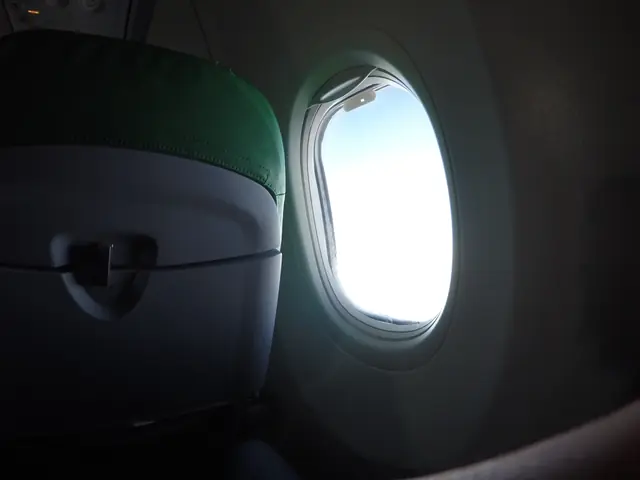
From sunset to sunrise, U.S. rules require aircraft to show lighted position lights, and aircraft with an anticollision light system must have it on too (the pilot in command may switch those off if conditions make that safer).2 If you see a light flashing out on the wing, that's not a warning sign. It's the plane doing exactly what it should so other aircraft can see it. On a cloudy night the flash can bounce back off the cloud and light up the window. That's normal too.
"Are the pilots tired?"
It's a very common night-flight worry, and there are firm rules here. Airline pilots must get a rest period of at least 10 consecutive hours before a duty period, and that rest must include at least 8 uninterrupted hours of sleep opportunity.4 If a pilot sees that their rest won't give them those eight hours, they must tell the airline and can't report for the flight until they've had it.4
Before each flight, every pilot must affirmatively state they're fit for duty. An airline can't assign a pilot who reports too fatigued, and can't keep a pilot on duty who reports being too fatigued to continue.3 And an airliner has two pilots up front, so one can take over if the other is unwell. For more, see what happens if a pilot gets sick?
Bumps and sounds in the dark
Turbulence at night is the same as turbulence by day. It just feels bigger when you can't see the clouds or the horizon. The FAA's advice doesn't change: keep your seat belt fastened whenever you're seated, including while you sleep, because turbulence can happen without warning.6 Buckle it over your blanket so the crew can see it without waking you. What pilots do in turbulence explains what's happening up front.
A quiet cabin also makes ordinary sounds stand out: a change in engine note as the plane levels off or starts down, the hum of the air system, the chime of the call bell. Sounds on a flight, explained goes through them one by one, so a new noise is a name, not a mystery.
A plan for the dark cabin
Night fear often shows up as a wave of panic in the quiet hours. The NHS says most panic attacks last between 5 and 20 minutes and, although frightening, aren't dangerous. During one, it suggests you stay where you are, breathe slowly and deeply, remind yourself it will pass, focus on something peaceful and remember it isn't life threatening.5
- Bring your own light. A downloaded show, a playlist or an audiobook gives your brain something to follow besides the dark.
- Keep the window shade the way that feels best. Some people like to see the wing lights; others feel calmer with the shade down. Either is fine.
- Breathe on a count. Our breathing timer keeps the rhythm for you.
- Tell the crew. "I'm a nervous flyer, especially at night" is enough. See should I tell the flight attendant I'm nervous?
- Don't chase sleep. If you're on an overnight flight, resting with your eyes closed still counts. Red-eye flight tips for anxiety has more.
If panic attacks keep happening, on planes or elsewhere, the NHS recommends seeing a doctor; talking therapies such as CBT are one of the main treatments.5 Travel help covers the practical side if a late flight is delayed or canceled.
If you'd like to prepare step by step, the 7-day program walks through each stage of a flight, including the moments that feel worst, one short day at a time. Days 1–2 are free.
The calm takeaway: at night the view changes, not the flight. Airliners at cruise fly on instruments with air traffic control day or night, the plane is lit so others can see it, pilots must be rested and declare themselves fit, and a panic wave in the dark still passes, usually within 5 to 20 minutes.
Keep reading
- Red-eye flight tips for anxiety
- Sounds on a flight, explained
- Can I get off the plane if I panic?
- Scared of landing? What to expect, minute by minute
- Scared to fly but it's a family emergency
Quick answers
Is it safe to fly at night?
Airliners are built and flown to the same rules after dark. In the high airspace where airliners cruise, every flight operates under instrument flight rules with an air traffic control clearance and radio contact, whether it's noon or midnight. The pilots navigate by instruments, not by looking out the window.
How do pilots see where they're going at night?
They don't need to see the ground to navigate. Flights at cruising altitude follow instrument flight rules and air traffic control clearances, and the aircraft must show lighted position lights from sunset to sunrise so other aircraft can see it.
Are pilots tired on night flights?
U.S. rules require airline pilots to get at least 10 consecutive hours of rest before a duty period, including 8 uninterrupted hours of sleep opportunity, and to state they are fit for duty before the flight. A pilot who reports being too fatigued can't be kept on duty.
Why does turbulence feel worse at night?
Usually because you can't see anything to explain it, and a tired mind fills the gap. Bumps at night are the same kind as bumps by day. Keep your seat belt fastened whenever you're seated, as the FAA advises, and use slow breathing to ride them out.
Sources
(6)
- 14 CFR § 91.135, Operations in Class A airspace
- 14 CFR § 91.209, Aircraft lights
- 14 CFR § 117.5, Fitness for duty
- 14 CFR § 117.25, Rest period
- NHS, Panic disorder
- FAA, Turbulence: staying safe
Facts last checked against these sources: November 17, 2026.