Everything pilots do to become airline pilots
Long before a pilot flies you anywhere, they've passed medical exams, earned four or more certificates and ratings, logged at least 1,500 hours (or a reduced number on a strictly defined path), completed airline training on that exact airplane, and flown real trips under a check pilot's eye. Then the testing keeps going for their whole career.
In this article · 11 sections
- The short answer
- Step 1: a medical certificate
- Step 2: private pilot
- Step 3: instrument rating
- Step 4: commercial pilot and multi-engine
- Step 5: building hours, often as an instructor
- Step 6: the airline transport pilot certificate
- Step 7: joining an airline
- Step 8: never-ending checks
- Outside the US
- Keep reading
Flying soon? Our 7-day program walks you through your trip one calm step a day, and you can try a lesson free first. See what's inside.
The short answer
Becoming an airline pilot in the US is a long ladder of tests, and every rung has a written standard. A pilot at a US airline has passed medical exams, earned several separate certificates and ratings, built at least 1,500 hours of flying (or a reduced number on a tightly defined path), trained on the exact airplane type in simulators, and flown real trips under supervision before flying without a check pilot. Then they keep being tested for their whole career.
Here's the path, step by step.1 The figures come straight from the FAA's rules, which are listed at the end.
Step 1: a medical certificate
Pilots need an FAA medical certificate from an aviation medical examiner, usually from early in their training. Airline captains need the most demanding level, a first-class medical. To use airline transport pilot privileges, it lasts 12 months for pilots under 40 and 6 months for pilots 40 and over.2 That means older airline pilots see a doctor for a flying medical twice a year.
Step 2: private pilot
The first certificate is the private pilot certificate. The rules require at least 40 hours of flight time, including 20 hours with an instructor and 10 hours of solo flying, along with a written knowledge test and a practical test with an examiner.3 Most people take more than the minimum.
Step 3: instrument rating
Next, pilots learn to fly by reference to instruments alone, in cloud and low visibility. The instrument rating needs 50 hours of cross-country flying as pilot in command and 40 hours of actual or simulated instrument time, at least 15 of them with an instrument instructor.4 This is the skill that lets airliners fly safely through weather.
Step 4: commercial pilot and multi-engine
The commercial pilot certificate allows a pilot to be paid to fly. It needs at least 250 hours of flight time, with set amounts of pilot-in-command, cross-country and advanced training.5 Pilots heading for the airlines also add a multi-engine rating, learning to handle an airplane with more than one engine, including what to do if one stops.
Step 5: building hours, often as an instructor
There's a big gap between the commercial certificate's 250 hours and the 1,500 hours an airline needs. Many pilots fill it by becoming flight instructors (CFIs). To be eligible, a pilot must be at least 18 and hold a commercial or airline transport certificate with an instrument rating.6 Teaching is a deep way to learn: you get very good at the basics when you're watching a student fly them every day. Others build time flying charter, cargo, banner towing, aerial survey or in the military.
Step 6: the airline transport pilot certificate
Since 2013, every pilot at the controls of a US airliner, first officer included, must hold an airline transport pilot (ATP) certificate.14
- Standard ATP: at least 23 years old and 1,500 hours of flight time, including 500 hours cross-country, 100 hours at night, 75 hours of instrument time and 250 hours as pilot in command (or a mix of that and certain supervised time).7
- Restricted ATP (R-ATP): a pilot can qualify with fewer hours at 21, on specific paths with structured training: 750 hours for qualifying military pilots, 1,000 hours for graduates of certain FAA-approved aviation bachelor's degrees, and 1,250 hours for certain associate's degrees or college credits.8
- ATP Certification Training Program (ATP-CTP): before the ATP test, pilots complete an approved course with at least 30 hours of classroom work and 10 hours in simulators, at least 6 of them in an advanced full flight simulator. It covers aerodynamics and high-altitude flight, weather, airline operations, leadership and crew resource management, and, in the simulator, stalls, upset recovery and flying in icing, storms and gusty crosswinds.9
Step 7: joining an airline
Getting hired is not the end of training; it's the start of a new phase.
- Indoctrination ground school. New-hire pilots get basic indoctrination training on the airline's procedures and rules, set by regulation at 40 programmed hours unless the airline has an approved reduction.10
- Crew resource management (CRM). No pilot can fly for a US airline without approved CRM training,13 which teaches crews to communicate, cross-check and speak up.
- Type rating. Each airliner type needs its own rating. Pilots spend weeks learning that airplane's systems, then train and are tested in full flight simulators, motion-based replicas of the cockpit where engine failures, fires, wind shear and other rare events can be practised safely.
- Operating experience (IOE). Then comes real flying with passengers, under the supervision of a check pilot. For jets, the minimum is 25 hours of operating experience, with at least 4 flights, 2 of them as the pilot flying.11 Only after signing off does the new pilot fly the line normally.
Some airlines use an FAA-approved alternative training program that tailors these hours, but the same standard of proof applies: the pilot must show they can do the job.
Step 8: never-ending checks
- Proficiency checks. A captain needs a proficiency check within the past 12 months, and within the past 6 months either another check or an approved simulator course. Other pilots need a check or simulator training every 12 months.12 These are tests, given by the FAA or a check pilot.
- Recurrent training every year, covering systems, procedures and emergencies on their airplane.
- Medicals every 6 or 12 months, as above.2
- Upgrading to captain takes more again: an ATP, a type rating, and at least 1,000 hours of airline-type flying such as time as a first officer,14 plus upgrade training that includes leadership and command.
For more on what happens after hiring, see how airline pilots train, and how often they're checked.
Outside the US
Other countries follow international (ICAO) standards, and in Europe EASA sets the rules for pilot licences and medicals.15 The steps and hour figures differ: many European pilots go through an integrated course at a flight school, and don't follow the US 1,500-hour model. The common thread is the same: medical checks, staged licences, type ratings in simulators and supervised line flying before full responsibility.
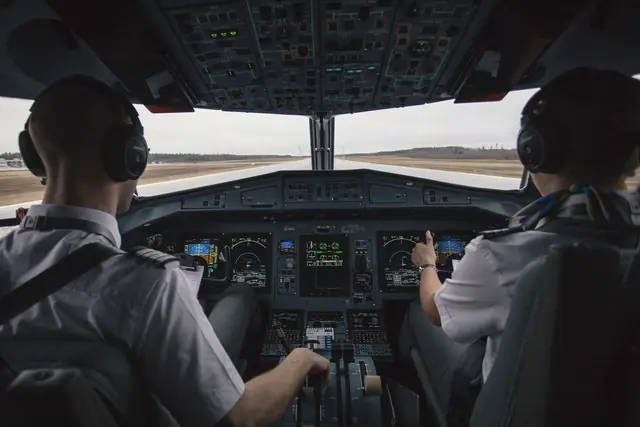
The calm takeaway: the two people in the cockpit have passed more exams, checks and medicals than most professionals ever face, and they're re-tested every year. If you're nervous, it's worth remembering just how much of their training is practising the rare things, so the everyday things feel routine.
Keep reading
- How do airline pilots train, and how often are they checked?
- What happens if a pilot gets sick mid-flight?
- How airplanes are stress-tested before they ever carry passengers
- On the plane and want a distraction? Try the cabin scavenger hunt or guided breathing.
- For a full week of preparation, try 7 days to your flight; the in-flight pack works offline once you've opened it, and the free newsletter sends calm explainers.
Quick answers
How many hours does it take to become an airline pilot in the US?
An airline transport pilot (ATP) certificate normally needs at least 1,500 hours of flight time. A restricted ATP is available with fewer hours on specific paths: 750 for qualifying military pilots, 1,000 for certain aviation bachelor's degrees and 1,250 for certain associate's degrees or credits.
What is the 1,500-hour rule?
It's the FAA requirement, in force since 2013, that airline first officers hold an ATP certificate. The standard ATP needs 1,500 hours total, including 500 cross-country, 100 at night, 75 instrument and 250 as pilot in command or a mix of that and certain supervised time.
Do new airline pilots fly passengers straight away?
No. After airline ground school and simulator training, a new pilot flies real trips under the supervision of a check pilot, called operating experience. For jets, the rules set a minimum of 25 hours of it.
How often are airline pilots checked?
Throughout their career. Captains need a proficiency check within the past 12 months plus another check or simulator course within the past 6 months, and pilots also have recurrent training every year and regular medical exams.
Sources
(15)
- FAA, Become a Pilot
- 14 CFR § 61.23, Medical certificates: requirement and duration
- 14 CFR § 61.109, Aeronautical experience (private pilot)
- 14 CFR § 61.65, Instrument rating requirements
- 14 CFR § 61.129, Aeronautical experience (commercial pilot)
- 14 CFR § 61.183, Flight instructor eligibility requirements
- 14 CFR § 61.159, Aeronautical experience: airplane category rating (ATP)
- 14 CFR § 61.160, Exceptions to the aeronautical experience requirements for an ATP certificate
- 14 CFR § 61.156, Training requirements: ATP with airplane category multiengine class rating
- 14 CFR § 121.415, Crewmember and dispatcher training program requirements
- 14 CFR § 121.434, Operating experience, operating cycles, and consolidation of knowledge and skills
- 14 CFR § 121.441, Proficiency checks
- 14 CFR § 121.404, Crew and dispatcher resource management training
- 14 CFR § 121.436, Pilot qualification: certificates and experience requirements
- EASA, Aircrew regulations
Facts last checked against these sources: October 28, 2026.